Error Recovery and Retry Logic in Autonomous Computer-Use Agents
Autonomous agents need error classification and circuit breakers to prevent cascading failures.
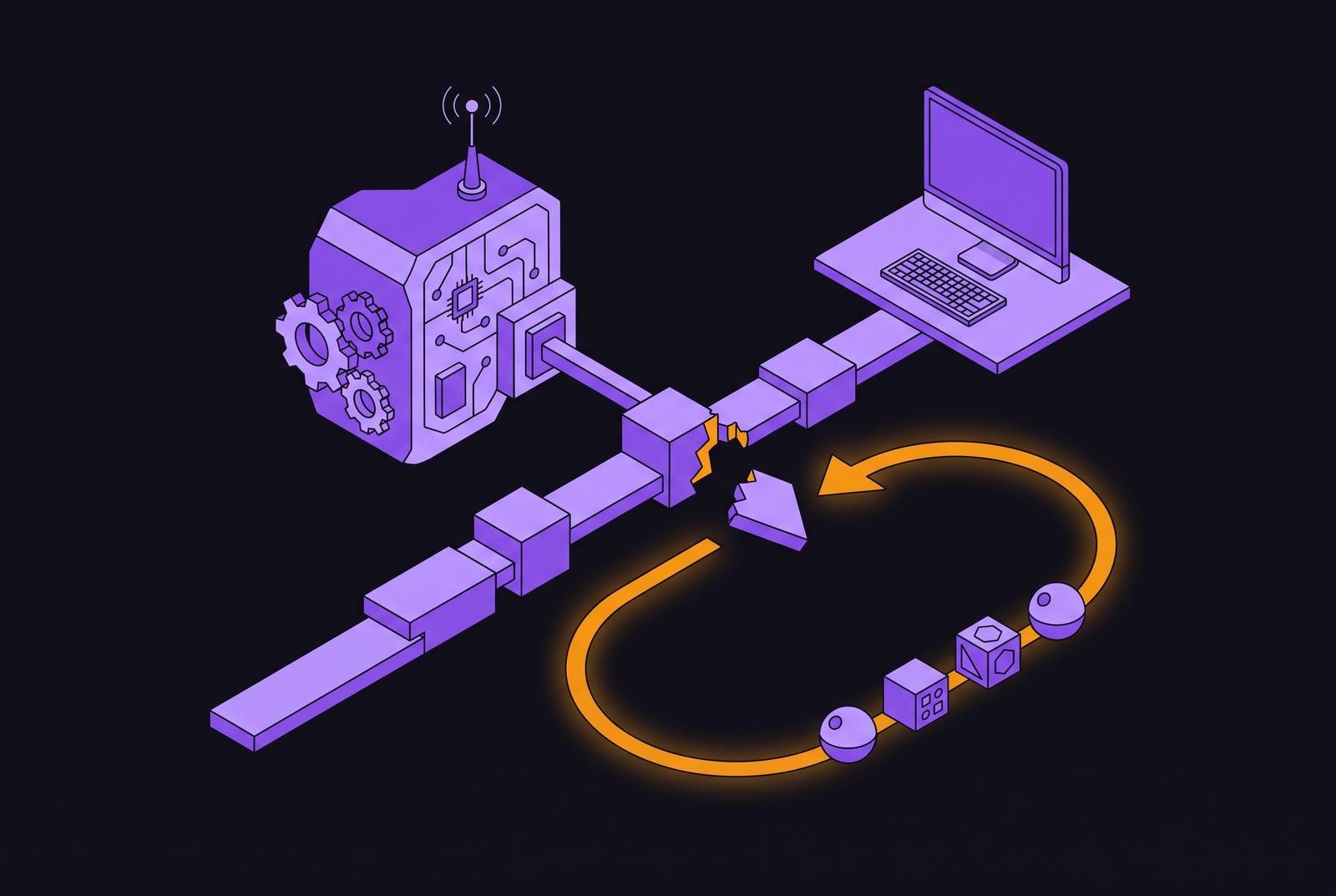
A conventional service that times out on a database call can retry the call, log the failure, and move on, because the unit of work is stateless and bounded. Autonomous computer-use agents break that assumption at the root: a single user request fans out into a graph of dependent LLM calls, tool invocations, and state mutations, and every node in that graph is its own failure site. Where a stateless RPC either succeeds or fails cleanly, an agent task is a stateful, multi-step graph in which a failure at step four leaves steps one through N already committed and steps five through N broken, with no clean boundary to retry against. The volume of exposure is also larger than it looks from the outside: agents make far more LLM calls than a simple chatbot does, because planning, tool selection, execution, verification, and response generation each carry an independent failure probability. Multiplying enough independent probabilities together turns a per-step reliability that looks reassuring on its own into something closer to a coin flip over a long task. The scale of the problem is not theoretical: the MAST study, presented at NeurIPS 2025 and built on hand-annotated analysis of more than 150 execution traces before being validated against a larger corpus, found multi-agent systems failing on real tasks at rates that would be treated as a full production incident in any other category of software.
A shared vocabulary for failure: the error taxonomy that makes systematic recovery possible
Systematic recovery depends on sorting failures into classes that dictate how each one gets handled, because a team that cannot classify an error will either retry something that will never clear or abandon something that would have resolved in milliseconds. Production systems converge on three top-level classes: transient errors, covering network hiccups, rate limits, and temporary unavailability; persistent errors, covering bad input, a missing resource, or an invalid output; and critical errors, covering budget overrun, a destructive side effect, or a security violation. The EFFGEN framework pushes this further into typed subtypes, naming ModelError, ToolError, ValidationError, ProviderTransientError, ProviderAuthError, and BudgetExceededError, each carrying its own default recovery strategy. Misclassifying an error carries asymmetric cost: retrying a persistent error burns through budget while masking the actual defect, and giving up on a transient error quietly erodes task completion without any alarm going off.
The MAST study adds a second, complementary lens by showing that failures are not scattered at random but cluster into 14 distinct modes across three root categories: specification issues, inter-agent misalignment, and task verification. That clustering matters because it means the classification space is bounded and learnable rather than open-ended. The MAST root categories map cleanly onto who owns the fix: specification failures require tighter scope and goal monitoring, coordination failures require orchestration and isolation between agents, and verification failures require reflection and output validation. That branch point is the single most consequential decision in any recovery loop, and everything described in the layers below is really a different answer to it.
Layer one, retry with backoff and jitter: the right defaults and the limits of naive retry
For transient errors, the correct first response is exponential backoff with jitter: wait time doubles after each failed attempt, which bounds how hard a retrying agent hammers a struggling dependency. Jitter, a randomized offset added to that wait time, is not an optional refinement. Without it, a fleet of agents that fails at the same moment retries at the same moment, too, turning what should have been a brief transient outage into a sustained one through a thundering-herd effect, and this is a documented production failure mode rather than a hypothetical one. Retry budgets also need a hard ceiling and active tracking, because unlimited retries against a dependency that has failed hard will quietly exhaust token budgets and stall every downstream agent waiting on that work.
Idempotency decides which of those retries are even safe to attempt. An operation that sends an email, submits a form, or executes a shell command cannot be retried blind, because a retry that succeeds on the second attempt after a false failure on the first produces a duplicate side effect rather than a correction. Practitioners at miaoquai.com learned this the costly way: a single network timeout triggered a retry storm that produced 50 duplicate Discord posts, after which they split their retry configuration into separate paths for idempotent and non-idempotent operations. Where the retry wrapper sits in the code determines which failures it actually catches. In frameworks such as AutoGen 0.4.x, most transient failures occur at the model client layer, so retry logic has to be attached there rather than at the level of the agent subclass; an agent that wraps retry logic at the wrong abstraction layer will silently miss most of the transient failures it was built to catch.
Layer two, circuit breakers: stopping cascades before they become incidents
Retry logic handles a single failing call. It does nothing to stop an agent from hammering a dependency that has entered a sustained failure state, and that gap is exactly where a circuit breaker belongs. A breaker tracks three states: closed, normal operation; open, the dependency has tripped and every call fails fast without even attempting the dependency; and half-open, a single probe request is allowed through to test whether the dependency has recovered. The AWS Well-Architected Agentic AI Lens recommends setting these thresholds per dependency rather than globally: an error rate threshold within a defined time window, a timeout threshold such as five consecutive timeouts, and a recovery probe interval, with the exact numbers tuned to each dependency's own reliability profile. Because a fleet of agents shares dependencies, breaker state has to live in a shared, fast data store reachable by every agent; a breaker that only exists in one process's memory protects that process and nothing else.
The cascade this is built to prevent is not an abstract concern. At miaoquai.com, a CRON agent failed silently at 3 a.m., a content agent downstream of it kept consuming its output, and a Discord agent downstream of that kept consuming the content agent's output; three hours later, 23 scheduled tasks had failed in a chain before anyone noticed. The fix was circuit breakers placed at every agent boundary, so that a downstream agent receives an explicit "degraded mode" signal instead of silently ingesting garbage from an upstream failure. That pattern is not an edge case. The MAST taxonomy attributes more than a third of observed failures to inter-agent coordination breakdowns, and circuit breakers placed at agent boundaries are a direct answer to that specific failure class. AWS flags the inverse as an anti-pattern: retry logic deployed without an automatic cutoff causes an agent to keep invoking a failing service and pile additional load onto an already degraded system rather than failing fast and giving that system room to recover.
Layer three, fallback chains: graceful degradation across models and tools
Once a circuit breaker has opened, the agent still has a task to finish if at all possible, and a fallback chain is what lets it finish that task at reduced capability instead of simply stopping. One common pattern is a model fallback chain that routes progressively down in capability and cost as retries accumulate: a primary large model, then a mid-tier model, then a lightweight model, with queuing for later retry as the final stop; this bounds the cost of the failure while keeping the odds of eventual completion as high as the situation allows. A tool fallback chain follows the same logic on the tool side: an alternative tool with roughly equivalent capability, then a path of graceful degradation, then manual escalation to a human, with each tool that is capable of failing needing its own fallback specified at design time rather than improvised in the moment it breaks. In a multi-agent system, the equivalent move is for the orchestrator to drop into single-agent mode and handle the task directly at reduced capability when a sub-agent becomes unavailable, instead of failing the whole task.
AWS Well-Architected guidance is explicit on one point that is easy to skip past: every fallback should tell the user that quality has been degraded. Returning a quietly worse answer without saying so is an anti-pattern, because it leaves the user with no basis for deciding whether to trust or double-check the result. These chains also have a cost dimension that resurfaces later: output tokens cost substantially more than input tokens across the current provider landscape, with a median output-to-input ratio around 4:1 and some reasoning models running higher; an agent that generates verbose chain-of-thought at every retry step pays that premium repeatedly. Model routing in a fallback chain is therefore a reliability decision and an economic one at the same time.
Layer four, checkpointing and resumption: preserving progress across failures in long-horizon tasks
Retry, circuit breaking, and fallback chains all assume the failure resolves quickly enough that the task can continue roughly where it left off. Long-horizon tasks break that assumption, because a failure partway through a multi-hour process can force a choice between expensive, possibly non-idempotent rework from scratch and some way of resuming from where things actually stood. A checkpoint is a snapshot of everything the agent currently knows about the task at that moment, including which step it is on, what the last tool call returned, and what variables it is tracking.
A practical version of this writes a session checkpoint every N messages or before every major operation, which keeps the recovery point recent enough that resuming from it does not mean repeating significant work. Writing that state to a shared memory file, the MEMORY.md pattern used at miaoquai.com, lets a system replay from the last valid checkpoint when a cascade failure occurs rather than restarting the entire task. A related technique logs a "before" snapshot ahead of every tool call that mutates state, paired with a rollback hook, so a failed operation can be undone cleanly instead of leaving the environment in some partial, ambiguous condition. The same principle scales up to the infrastructure layer through durable execution: a harness that snapshots full state, including memory, call stack, and any pending continuations, to durable storage, then terminates the running process entirely and restores it in milliseconds when work needs to resume. That approach does double duty, functioning as a reliability mechanism and, because compute drops to zero while the process is suspended, as a cost mechanism as well.
How much this matters becomes concrete in the ParaRecover benchmark, introduced by Guan et al. of Dalian University of Technology, which spans thousands of instances across two difficulty levels built specifically to test an agent's intermediate decision-making, its error localization, and its corrective replanning. The benchmark's Level-2 difficulty involves multi-turn propagation of errors across steps, precisely the scenario in which the presence or absence of a checkpoint decides whether recovery is possible at all.
Layer five, reasoning-level self-correction: reflection and replanning from within the agent
Everything above addresses infrastructure and orchestration failures, places where a call fails, a dependency degrades, or a process dies mid-task. None of it catches the failure mode where every API call returns success and the output is simply wrong. A confidence failure is arguably the most dangerous class in the whole taxonomy precisely because nothing in the infrastructure stack flags it: the agent believes it has succeeded, every external system reports success, and the output is still incorrect. The canonical case is an RSS agent at miaoquai.com that "successfully" posted 47 duplicate news items, with no infrastructure error anywhere in the chain to catch.
Catching that class of failure requires a correction mechanism built into the agent's own reasoning loop rather than into its surrounding scaffolding. Reflexion, introduced by Shinn et al. in 2023, remains the standard primitive for this in production stacks: the agent generates a reflective critique of its own prior output and uses that critique to improve the next attempt, a form of verbal reinforcement learning rather than a gradient update. A systematic complement to that in-loop reflection is post-execution validation, a separate, lightweight check run after every batch operation that confirms the output matches expectations: no duplicates, a reasonable count, no obvious hallucination, evaluated independently of whatever the agent itself believes it accomplished. ParaRecover's SDE rubric, covering Structural Integrity, Diagnostic Reasoning, and Evolutionary Strategy, measures exactly this capability: whether an agent can correctly localize a failure inside a parallel tool-use execution, diagnose what caused it, and replan around it. Tested across more than ten mainstream LLMs, even state-of-the-art models still struggle with multi-turn error propagation, implicit tool-use failures, and precise replanning.
A second benchmark, BackBench, from Li et al., formalizes a related problem it calls harm recovery: steering an agent from a harmful state back to a safe one in the most effective way available. Its dataset of pairwise human judgments shows that what counts as a good recovery plan depends heavily on context, so recovery quality cannot be reduced to one universal criterion that applies across situations. None of this reasoning-level correction comes free, either. An agent that runs verbose chain-of-thought on every single retry step compounds the same output-token premium described earlier, so the reflection layer needs to trigger on genuine uncertainty or a flagged post-execution anomaly rather than firing on every step by default.
Layer six, error localization in parallel and multi-agent workflows
Single-agent recovery, however demanding, is at least tractable: one execution trace, one chain of state, one place to look for what went wrong. Parallel tool-use and multi-agent workflows add a problem that single-agent recovery never has to face, which is figuring out which branch among several concurrent ones actually caused the failure and which of the downstream branches, if any, are still salvageable without being rerun from scratch. Rerunning everything is always safe and always wasteful; rerunning nothing risks propagating a bad result through work that depended on it. Getting error localization right in a parallel or multi-agent system is what decides whether a single bad branch costs the time it actually wasted, or costs the entire task.
Sources
- AI Agent Error Handling & Self-Healing Patterns (2026)
- EffGen: Enabling Small Language Models as Capable Autonomous Agents
- What patterns do you use for AI agent error recovery? · anthropics/anthropic-sdk-python · Discussion #1341
- ParaRecover: A Process-Level Benchmark for Error Localization and Recovery in Parallel Tool-Use Agents
- AGENTOPS07-BP01 Implement automated response and recovery mechanisms - Agentic AI Lens
- Human-Guided Harm Recovery for Computer Use Agents