Authentication State Management Across Browser Agent Sessions
How to persist authentication across stateless agent runs without breaking under production load.
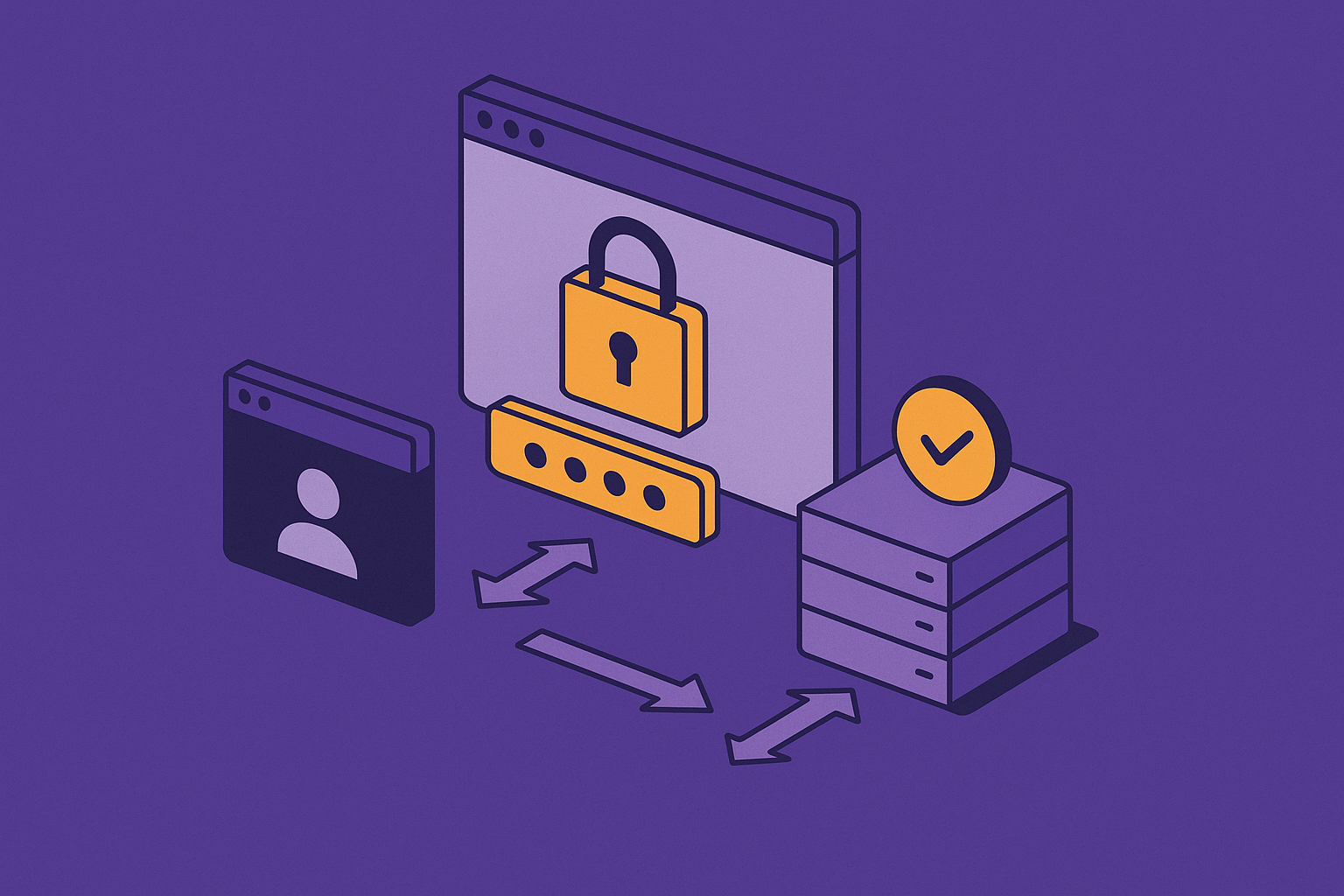
Authentication state management for browser agents has no established playbook, because the problem itself is new: agents don't persist memory between runs the way a human's browser does, and every naive fix that treats agent sessions like traditional web sessions breaks under real conditions. The argument here is structural. Once you see why agent authentication differs from human authentication at the level of what persists and what doesn't, the rest of the architecture, storage, parallelism, isolation, and anti-bot defenses, follows as a matter of necessity.
Authentication state in browser agents versus traditional web sessions
A human who logs into a website keeps a browser open, and that browser quietly holds onto cookies, localStorage, and sessionStorage for as long as the tab or profile survives. A browser agent doesn't get that for free. When an agent's run ends, the compute environment behind it is usually torn down, and whatever state lived inside that environment goes with it. A research position paper on collaborative agentic AI makes the underlying point directly: agent interactions are inherently stateful, and agents engage in conversations where each interaction changes the internal state of the agent or the environment. Yet the same paper notes that most agentic frameworks adopt stateless designs or delegate state management entirely to developers. Agent behavior is stateful while agent infrastructure is built stateless, and that mismatch is why authentication breaks.
You can see the practical result immediately in any multi-run agent workflow. An agent that completes a login in run N has no record of that login in run N+1, and that isn't because the login failed or because a token expired. Statelessness is the default condition an agent starts from, every time, unless someone has deliberately built a memory layer underneath it. This is a different failure category than anything in traditional web development. An agent starting a new run begins from a compute environment that holds nothing at all, because the previous one no longer exists.
This distinction matters because authentication state for a web application is rarely just a cookie. It isn't, and that incompleteness is the most common production failure mode in agent authentication: everything appears to work until a form submission or token refresh exposes a credential fragment that never got saved.
What serialized browser state contains
Serializing browser state is the correct starting point for solving this problem, but its actual scope is narrower than most developers assume going in, and two specific production limits make a naive implementation unreliable. Browser automation frameworks, including browser-use, support a storage_state mechanism that correctly captures cookies, localStorage, and sessionStorage as part of a single saved object. But the saved JSON from this process doesn't include DOM state. Authentication has in fact been restored at the storage layer, but the agent still has to navigate back to a page before it can act on that authentication.
The first production limit sits in server-side validity. A serialized session file records what the client-side browser believes about its own authentication, not what the server currently believes. A session file can look entirely valid on disk while the server that issued it has already invalidated the underlying token. There's no way to tell from the file alone; the only way to know is to try using it and watch for a rejection.
The second limit concerns sessionStorage specifically. The agent comes back authenticated, but it comes back to a blank page, and it may hit a missing CSRF token the moment it tries to submit a form. Developers who treat "restore the session" and "resume the session" as equivalent operations are the ones who get paged when a form submission fails for no apparent reason.
Structuring session state storage for validation, expiration, and recovery
Because of these limits, a production session store needs to meet certain requirements if it's going to work. A production-grade store needs, at minimum, a timestamp recording when the session was captured, a TTL that reflects the actual token lifetime of the target service, and some form of flag or checksum that lets the agent detect a corrupted or partially written state file before attempting to use it.
The TTL has to be set per target service rather than applied as one global value across every integration. If a service issues aggressive 15-minute sliding-window tokens, you need a TTL set far shorter than one built around long-lived OAuth refresh tokens that might remain valid for weeks. Treating these two cases the same way guarantees one of two failures: either the agent discards sessions that are still perfectly valid, wasting a login cycle for no reason, or it tries to reuse sessions well past the point the server stopped honoring them.
You need to design recovery behavior as carefully as the successful restore path, because the load function has to respond to three distinct cases. For deployments serving multiple users or multiple accounts, session files also need to be namespaced per user or per account; a shared session file across accounts is a direct cross-contamination risk, handing one user's authenticated session to another user's agent run.
Checkpointing extends this same logic beyond authentication into the broader shape of a workflow. An agent that times out partway through a multi-step task, without a checkpoint to fall back on, has to restart the entire workflow from the beginning, including re-authenticating, re-navigating to wherever it was, and redoing every step it had already completed. The fix is to write workflow state, the current URL, the steps already completed, and the actions still pending, to an external store alongside the session state itself, so that a restore operation picks up both the authentication and the workflow position in a single step.
Parallel agent sessions and authentication failure
A session management approach that works fine for one agent running one task at a time can fail the moment an operator tries to scale it across many parallel sessions, and the failure is a different kind of problem, not a matter of degree. The concrete failure mode looks like this: an agent fanning out fifty parallel browser sessions, each logging in independently, produces a burst of login attempts that identity providers pattern-match against credential-stuffing attacks. Rate limits and account lockouts triggered by that pattern-matching apply indiscriminately, so legitimate automated sessions get caught in the same net as genuinely malicious traffic.
Identity providers rely on MFA as their primary control against account takeover attempts, so repeated logins from many distinct, fresh browser fingerprints also tend to re-trigger multi-factor authentication challenges. Bot detection systems compound the problem further: each fresh-fingerprint login attempt carries behavioral signals that automated traffic analysis tools score for suspicion, and that risk climbs as the session count climbs.
The architecture that actually solves this inverts the naive approach. Instead of having each of fifty parallel sessions log in independently, the correct pattern is to log in once, capture the complete authentication state from that single session, and pre-load it into each of the fifty sessions at initialization, so every session boots already authenticated. The state that has to travel with each of those sessions is the same full bundle discussed earlier: cookies, localStorage, sessionStorage, and IndexedDB, not cookies alone, for exactly the reasons already established.
Sharing that initial state across parallel sessions introduces a new requirement that single-session architectures never had to deal with: isolation of subsequent mutations. The pattern that avoids this treats the shared auth state as read-only at the moment of initialization. Each parallel session receives its own isolated copy to mutate freely during execution, and any write-back to the shared store afterward is gated, either through a single designated primary session responsible for persisting updates, or through a merge step that runs after all parallel sessions have completed. But making this isolation actually work depends on infrastructure decisions made well below the application layer.
How VM-level isolation changes session state management
The isolation requirement described above isn't just a logical constraint to enforce in application code; it depends on what the underlying compute infrastructure actually permits. A compromised or misbehaving agent session running in that environment can, in principle, affect co-resident sessions through kernel-level escape paths, because the isolation boundary stops at the container layer and doesn't extend any further down.
A micro-VM changes that boundary by giving each agent its own kernel. The isolation becomes complete at every level, not just at the filesystem or process level, and that distinction matters directly for authentication when agents are holding active, authenticated sessions to sensitive systems such as HR platforms, finance portals, or CRMs, where a session bleeding across tenants isn't a minor bug but a serious exposure. For browser agents specifically, this means the entire browser process, along with every cookie, token, and localStorage entry it holds, sits inside a private kernel boundary that other co-resident agent processes simply cannot reach.
But running a dedicated micro-VM per agent only makes economic sense because of snapshot-restore. Restore works by memory-mapping the snapshot file, loading CPU state, and resuming execution from exactly the instruction where the machine left off. The session survives that idle gap without any manual serialization step or re-authentication logic written into the application.
Anti-bot detection and session presentation for agents
Even if you've serialized a session completely and isolated it correctly at the VM level, it can still get blocked, because detection systems don't only check whether valid credentials are present. They score the behavioral and fingerprint signals surrounding how those credentials show up. A session presenting valid cookies alongside an automated browser fingerprint, visible headless-rendering artifacts, or interaction timing that doesn't resemble human behavior gets flagged by anti-bot systems regardless of whether the underlying credentials are entirely legitimate.
This creates a specific operational hazard: a session state file captured from a human logging in through a headed browser may not transfer cleanly onto a headless agent browser later, because the fingerprint difference between where the session was originally created and where it's later restored is itself a signal detection systems watch for. Proxy configuration adds a second dimension to this same problem. The practical implication for session architecture follows directly: wherever a session gets captured, in terms of browser environment, IP address, and fingerprint profile, should match as closely as possible wherever that session will later be restored and used.
A second adversarial surface sits alongside anti-bot detection: prompt injection, where an attacker embeds instructions into page content that an agent reads, hoping to hijack the authenticated session the agent is currently holding. As of mid-2026, indirect prompt injection, meaning instructions hidden inside page content through comments, white-on-white text, or invisible HTML, remains an unsolved problem in LLM security research. The dangerous scenario is specific: an agent reads an injected instruction while it's in the middle of a completely legitimate, authenticated task, and the authentication layer itself cannot tell a legitimate instruction from an injected one.
VM-level isolation doesn't close this gap. A sandboxed agent holding an active authenticated session remains just as vulnerable to prompt injection within the boundaries of that session as an unsandboxed one would be. What isolation provides instead is containment: the injected instruction cannot reach past the agent's own VM boundary to touch other agents' sessions or the host system underneath them. That containment argument is why VM-level isolation earns its place in the security conversation as well as the economic one. A shared-kernel agent fleet carrying a single prompt-injection vulnerability exposes every co-resident session to that same injected instruction at once, turning one compromised page into a fleet-wide incident.
A complete session lifecycle architecture that handles the production failure modes
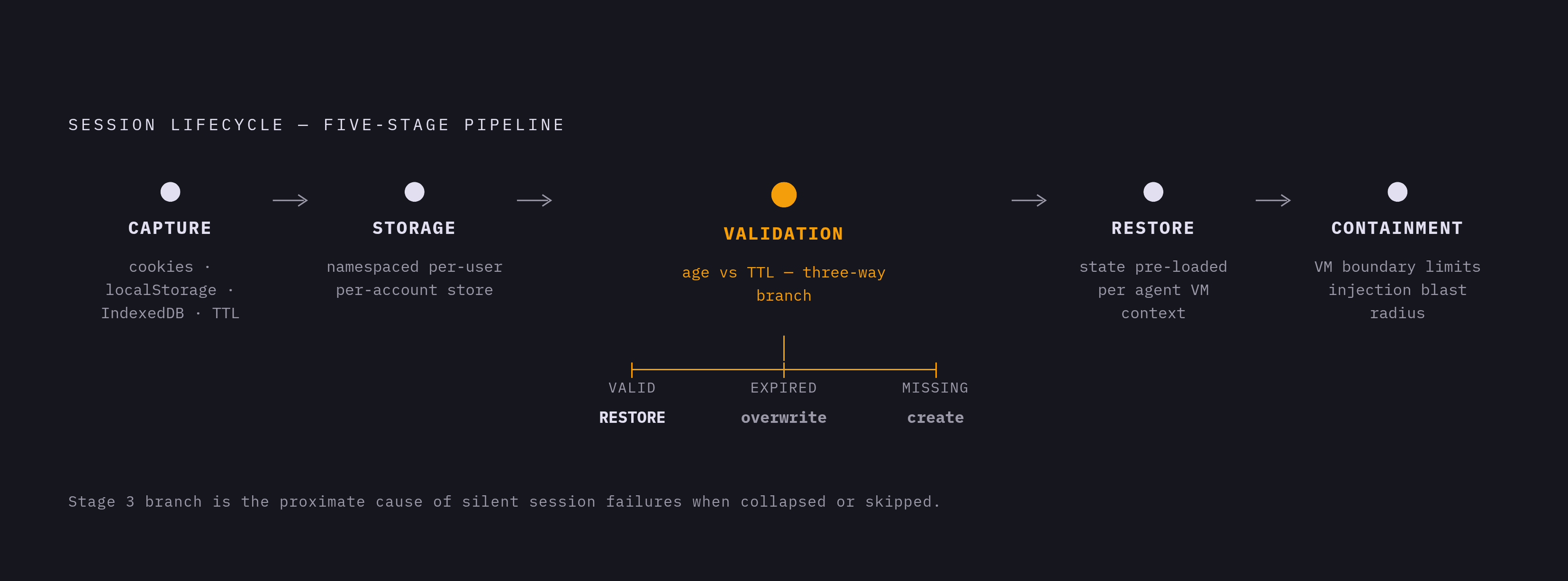
Every failure mode covered so far, the incomplete serialization, the missing validity checks, the parallel login storms, the shared-kernel exposure, the fingerprint mismatch, traces back to skipping or collapsing one stage of what should be a five-stage session lifecycle. Each stage carries a distinct responsibility, and none of them substitutes for another.
The first stage is capture. Authentication happens once, inside a browser environment that matches as closely as possible wherever the agent will eventually run, matching fingerprint, IP, and rendering mode together. The capture step pulls the complete state bundle, meaning cookies, localStorage, sessionStorage, and IndexedDB rather than cookies alone, and wraps that bundle with a timestamp and a TTL derived from the actual token lifetime of the target service.
The second stage is storage. In any multi-tenant deployment, you need each user's session store to remain fully isolated from every other user's.
The third stage is validation on load. Before anything gets restored, the system computes the session's age against its saved timestamp and configured TTL, and responds according to one of three defined outcomes: a valid session gets restored, an expired session triggers a fresh login that overwrites the stale file, and a missing session triggers a fresh login that creates one. An expired session should never be used silently under any circumstance.
The fourth stage is restore and isolation. The validated state gets pre-loaded into each agent's browser context at initialization, rather than having the agent attempt to log in at runtime, and that context runs inside its own VM boundary so that parallel sessions can share the same initial state without exposing each other's subsequent mutations. Together, these four stages, backed by the containment that VM-level isolation provides against the fifth and hardest problem, adversarial manipulation of an authenticated session through prompt injection, form the complete architecture a production browser agent fleet needs. None of the five stages is optional, and skipping any one of them reintroduces exactly the failure mode that stage exists to prevent.