Web Search Integration in Autonomous Browser Agents
Persistent state infrastructure is what separates functional browser agents from broken ones.
Say an agent logs into a retailer's site and builds a shopping cart across three tabs, then the underlying process restarts and interrupts it. The authentication token is gone. The cart is gone. The comparison it had been building against a competitor's prices is gone. Web search integration in autonomous browser agents only pays off on multi-step, stateful tasks, and those tasks are architecturally impossible to finish without persistent state behind them. An agent that loses its session between steps isn't simply slower at finishing stateful tasks: it cannot complete them, no matter how capable the underlying model is.
Autonomous browser agents and web search
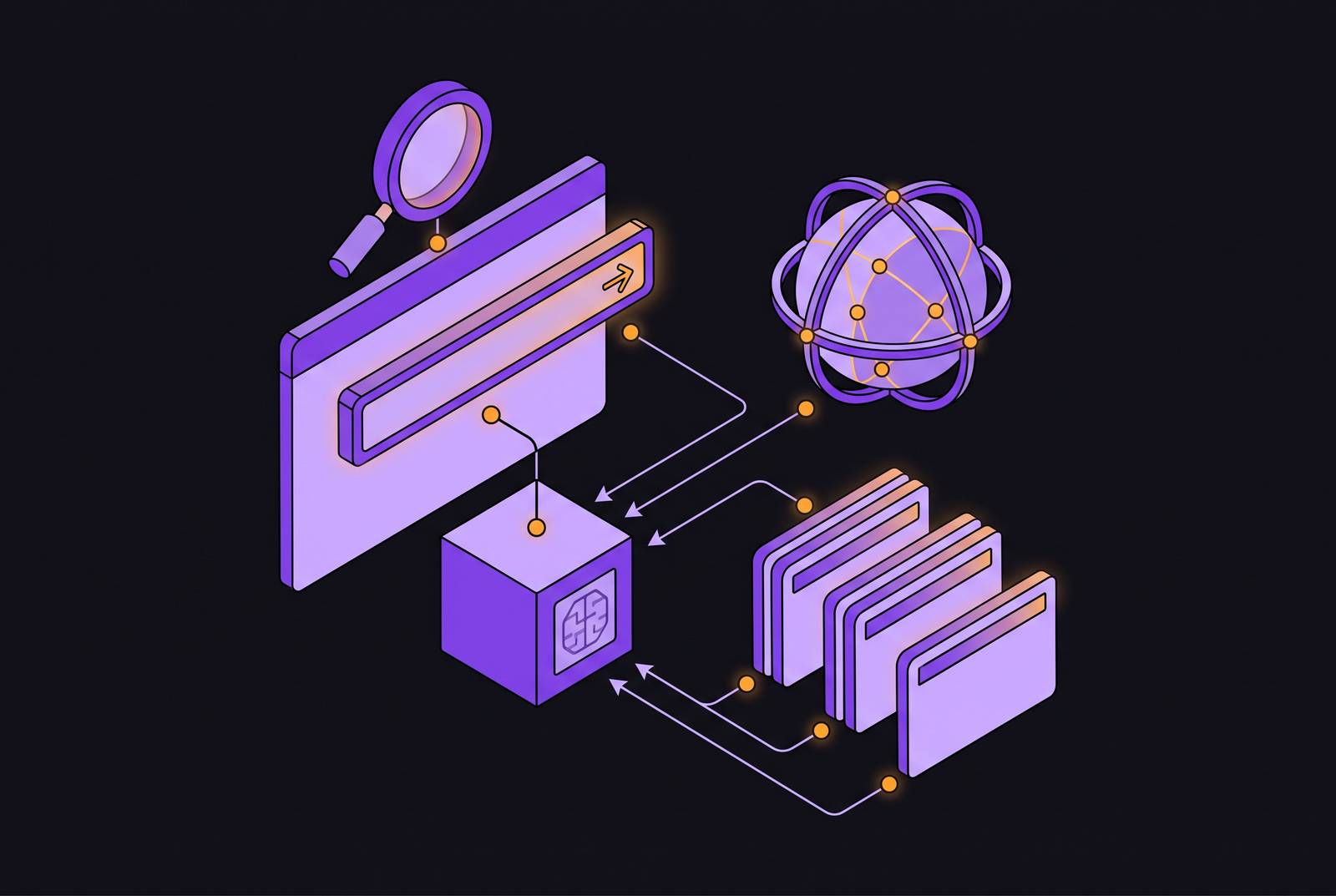
Browser agents execute web search as a sequence of discrete, stateful actions rather than a one-shot query, and each action in that sequence writes state that the next action has to read. Formal models of this process describe human-inspired browsing actions, scrolling, clicking, typing, navigating, each one dependent on the accumulated context of the steps that came before it. Agentic browser execution involves intent interpretation, website analysis, action planning, execution with adaptation, result validation, and learning from each interaction, and all of it accumulates state that has to go somewhere.
Four categories of state build up during a real search task. Credentials are needed to reach paywalled, authenticated, or personalized content, which is often the entire point of the task.
The LLM functions as the reasoning core, but it can't hold all of this in a context window indefinitely. Durable state has to live outside the process. The action loop that powers real web search integration, interpreting intent, analyzing page structure, planning, executing, adapting, validating, carrying forward context, accumulates structured state that must outlive individual steps. Running an agent on persistent infrastructure means each step can write to a durable disk and read what the previous step wrote, without burning tokens on context windows or rebuilding session state from scratch.
The three architectural tiers of today's browser agent ecosystem
The browser agent market has split into three distinct tiers: consumer AI browsers, open-source agent frameworks, and managed infrastructure. Each tier bets, implicitly, that persistent state is either the builder's problem to solve or the platform's.
Consumer AI browsers are agents built into or alongside a browser, and they aim at end-users who are completing personal tasks. Perplexity Comet combines Perplexity AI search with an integrated assistant, and it's suited to conversational research. Its cross-platform rollout ended on March 18, 2026, when it launched on iOS, after desktop and Android had already gone free worldwide starting in October 2025. Microsoft Edge with Copilot builds Copilot directly into the browser to summarize content, compare across tabs, and automate multi-step workflows with user approval, making it a fit for everyday productivity work.
Open-source agent frameworks occupy the second tier: developer tools for building custom browser agents, not finished products on their own. Browser Use is a free open-source framework (beyond LLM costs), and it posted a state-of-the-art score on the WebVoyager benchmark while carrying more than 97,000 GitHub stars. Stagehand is an open-source SDK available in TypeScript, Python, and Go, with more than 23,000 GitHub stars; its v3 release launched in October 2025 and is noted as 44% faster, built natively on CDP. Skyvern combines an open-source core with a cloud offering for no-code workflow automation; it scores 85.85% on the WebVoyager benchmark for general web navigation tasks and carries over 23,000 GitHub stars. Nanobrowser is an open-source browser extension for local web automation that lets developers bring their own LLM keys, fitting self-hosted, privacy-first deployments.
Managed infrastructure makes up the third tier: platforms that supply the browser sessions, persistence, and scalability the frameworks and consumer products depend on underneath. Firecrawl, including its Browser Sandbox product, provides managed browser sessions on top of search and scrape functionality, priced per-page credit with a free tier followed by $19 a month and up (or $16 a month billed annually), and carries more than 180,000 GitHub stars as a web data layer.
The tier that controls the browser session controls whether state persists. Consumer browsers handle this for their own users, but developers building agent products have to solve it at the infrastructure tier themselves. Frameworks like Browser Use and Stagehand are powerful reasoning engines, but they're agnostic about where session state actually lives, leaving that as the builder's responsibility. Managed infrastructure platforms abstract session management away from the developer, but their persistence guarantees and isolation models vary significantly from one to the next, which is exactly where the real evaluation work has to happen.
Why stateless execution environments break browser agent reliability
Stateless execution environments introduce failure modes that no amount of LLM reasoning can fix, because the reasoning layer depends on state the environment has already thrown away. Context amnesia follows from the same root cause: without durable state outside the process, an agent can't learn from a failed step in a previous session and will repeat the same mistake. Credential fragility rounds out the list, since credentials stored only in ephemeral memory vanish on any restart, forcing either insecure re-injection or manual re-entry.
Browser agents also face challenges specific to the web that compound these failures further. Anti-bot measures add a further wrinkle: they detect the behavioral signature of agents that restart cleanly. Session continuity itself functions as a stealth signal.
Attribution and fingerprinting research sharpens the stakes here. Persistent sessions with continuous behavioral profiles are harder to distinguish from human browsing than cold-start sessions with clean slates, which gives statelessness a cost beyond reliability: it makes agents easier to flag and block.
What genuine session persistence requires at the infrastructure level
Real session persistence for browser agents can't just be a software feature bolted onto a stateless platform after the fact. The infrastructure itself has to provide isolated, durable compute with snapshot-level state preservation built in from the start. A persistent disk has to hold cookies, credentials, downloaded files, and browser profiles across sessions. A real kernel environment has to be available for a full browser to run on, rather than a stripped container lacking the OS primitives a headless browser depends on. Isolation has to exist per agent, so one agent's session state can't leak into another's, and that matters most in multi-tenant deployments where each user needs a browser context of their own. Wake latency has to be fast enough that a restored session resumes before a web request times out or a session token expires; under one second is a functional requirement here, not a nice-to-have.
Firecracker micro-VMs have emerged as the infrastructure substrate that satisfies these requirements. Snapshot-restore is what turns this into sub-second wake from a persisted state. Firecracker's copy-on-write memory mapping means that restored agents sharing a common template also share read-only pages in the host page cache, so memory cost scales with how many agents are active.
Maritime's per-agent VM model and browser agent session requirements
Maritime's architecture runs one Firecracker micro-VM per agent, each with a persistent disk and snapshot-restore scheduling, which addresses the stateful session requirements browser agents need and that stateless platforms structurally cannot provide. A persistent disk means files, credentials, cookies, browser profiles, and downloaded data survive sleep and redeploy, so the session is durable by default rather than reconstructed on every wake. With a real kernel, the agent can install a full browser, manage packages, and run arbitrary processes, and it skips the stripped-down container constraints that break headless browser dependencies elsewhere. True isolation keeps one agent's session state from reaching another's, and that matters for per-user browser agents, where privacy and context separation both have to hold. Sub-second wake brings a sleeping agent back to its last browser state fast enough that it can resume a session before its tokens expire.
This is the per-user agent model, and it gives browser agent products their architecturally correct shape. Each user of an agent-powered product gets a VM of their own, with their own browser context: credentials, history, and preferences isolated and persistent rather than shared or reconstructed from scratch on each session. Maritime's snapshot-and-restore scheduler means idle agents pay for storage rather than compute, making per-user VM deployment economically viable at scale. Most agents sit idle most of the time, and Maritime's flat rate of roughly $1 per agent per month is built on exactly that insight about usage patterns. For developers building browser agent products on this kind of platform, the deployment path is direct: each agent gets a persistent disk, package installation privileges, and the ability to run browser sessions, so the work consists of shipping code. Maritime is aimed at developers and startups building agent-powered products who need real compute infrastructure rather than serverless workarounds bolted on after the fact.
The economics of running browser agents at scale without idle compute waste
The cost structure of browser agent deployment at scale is dominated by idle compute, so if a team solves that with snapshot-restore scheduling, they can ship per-user agents that teams running on always-on infrastructure can't match. Browser agents run intensively during a task and then go dormant, sometimes for hours, sometimes for days, while traditional cloud billing assumes workloads that stay continuously active. That mismatch is what makes always-on sandbox costs spiral. The idle-cost problem is structural rather than incidental: paying for compute during dormancy buys nothing, and at scale, that waste is what decides whether per-user agents are viable.
Snapshot-restore is the economic model that fits a bursty browser agent workload. The alternative, warm pools of always-on browser sessions, carries a continuous compute cost that grows linearly with the number of users regardless of how active any of them actually are.
Checkpoint-and-restore approaches built on container registries introduce a different cost trap. Local NVMe snapshot-restore sidesteps this entirely, since the snapshot never leaves the host and no egress charge ever applies to it.
Infrastructure and orchestration costs dominate the total cost of running an agent, with model inference making up only a minority share of the total spend. Optimizing the infrastructure layer has a larger effect on total cost per task than optimizing the model does, which makes the choice of execution environment the primary economic lever available to a team running agents at scale.
Protocol-level changes that will deepen the infrastructure dependency
The web is actively adding agent-native protocol layers, including MCP, WebMCP, and emerging agent-to-agent standards, and the agents able to participate in these protocols are the ones that maintain persistent identity and state. MCP, the Model Context Protocol, has become the dominant integration standard for how tools, data sources, and agents interact. Anthropic open-sourced MCP in November 2024, standardizing that interaction through a consistent JSON-RPC protocol. Google released an early preview of WebMCP in Chrome Canary in February 2026, putting agent interoperability protocols directly inside the browser. WebMCP has since reached a second browser engine and its first mainstream agent client, so it is now spreading beyond Chrome.
This shift is also creating new security and attribution requirements that favor persistent, isolated agent identities over ephemeral ones. Research on multi-layer fingerprinting of autonomous web agents shows agents are increasingly identifiable by behavioral and infrastructure signals, so operators will need to manage persistent agent identities. The agentic web is building new requirements around how agents identify themselves, what permissions they carry, and how their actions get attributed, and all three of those requirements depend on durable agent state existing somewhere.
Choosing infrastructure for a browser agent product
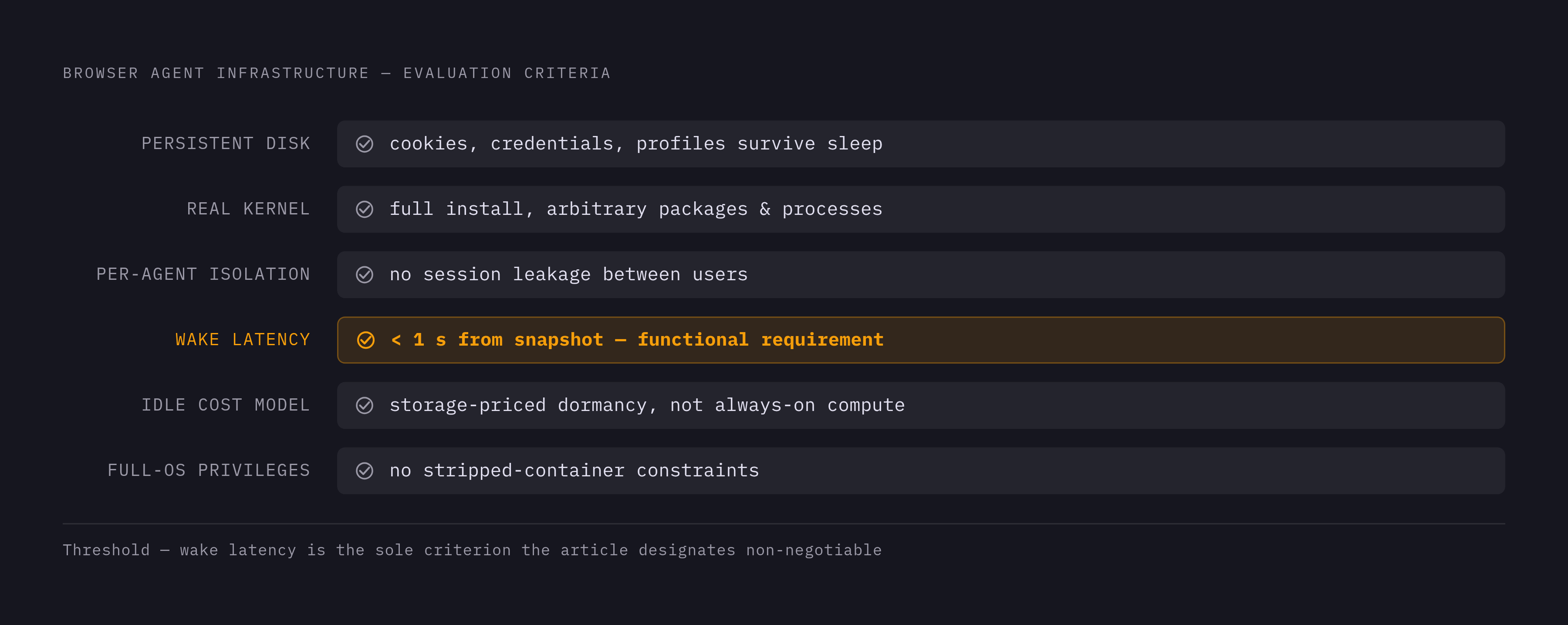
Choosing browser agent infrastructure is really a decision about which failure modes a team is willing to accept, and the checklist that matters isn't a feature count but whether the platform satisfies the stateful execution requirements that multi-step web tasks demand. The third is wake latency from a snapshotted state, where under one second is a functional requirement for a responsive agent product and anything slower risks session expiry and delays the user can see. The fourth is whether the agent can install packages, run a full browser, and operate with real OS privileges, since stripped container environments break the browser dependencies these agents depend on. The fifth is the idle cost model: always-on pricing makes per-user agents economically unviable at scale, while storage-priced dormancy fits the bursty nature of this workload. The sixth is whether the isolation model holds up for per-user deployment: one user's browser session, credentials, and history must never be visible to another user's agent.
Measured against these criteria, the existing tiers each have a clear shape. Maritime gives each agent its own Firecracker micro-VM with a persistent disk, a real kernel, and snapshot-restore scheduling, satisfying all six criteria by design, with per-agent pricing built on the insight that most agents are dormant most of the time. Consumer browsers and open-source frameworks leave persistent state as the developer's responsibility, often forcing workarounds like token-expensive context padding or external databases; dedicated agent infrastructure platforms give each agent its own VM and filesystem, making multi-step stateful browsing the default behavior.
If you want to minimize infrastructure overhead, you ship code to a live API endpoint without anyone managing VMs, networking, or snapshot scheduling by hand. The right infrastructure layer makes persistence the default rather than a feature a developer has to engineer themselves, so the agent wakes exactly where it fell asleep, browser context intact, ready to pick the task back up where it left off.