CAPTCHA and Anti-Bot Handling in Browser Agent Infrastructure
Agents need persistent identity, not just smarter tricks, to bypass bot defenses.
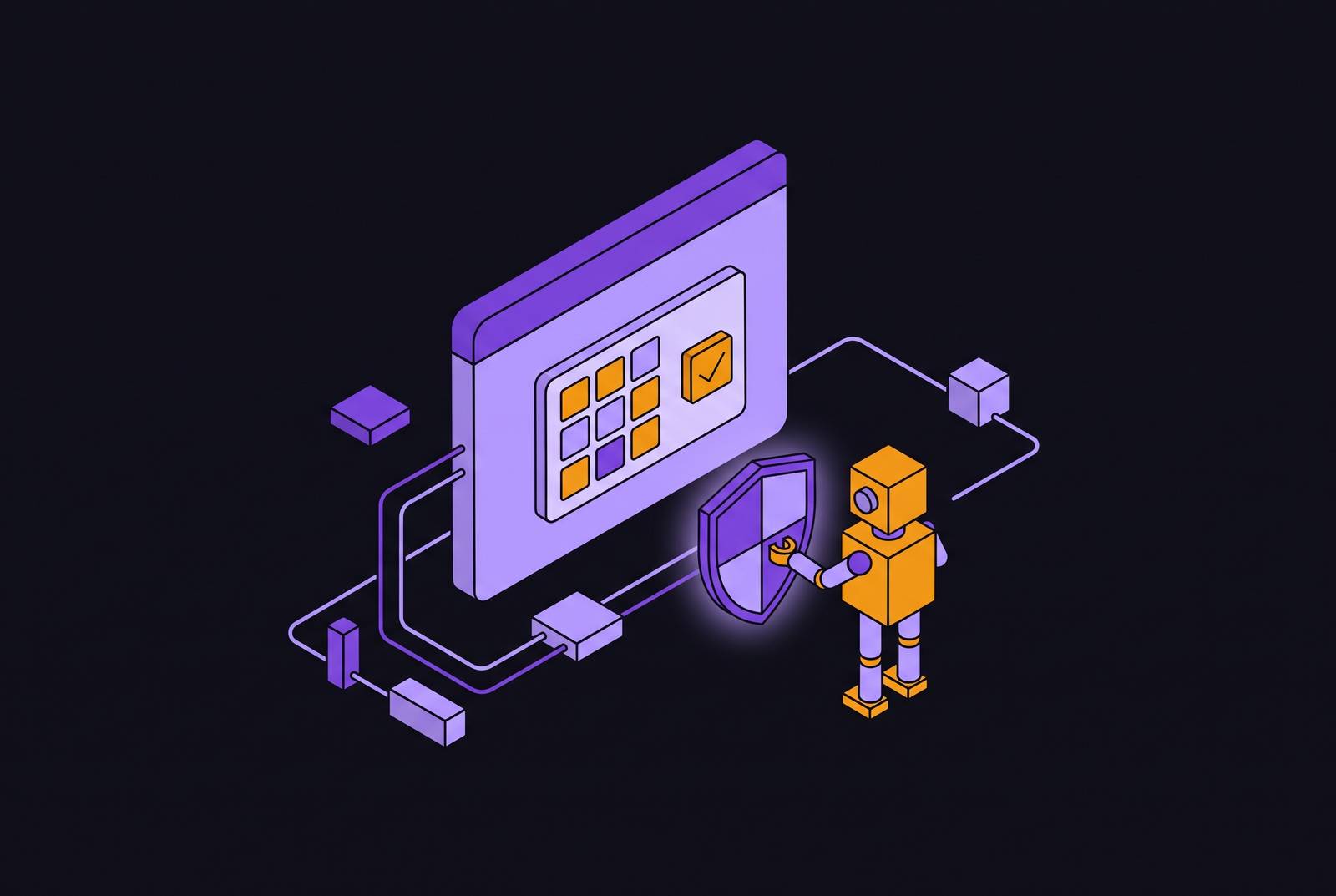
If you ask an AI agent to book a restaurant reservation or compare insurance quotes across five sites, it opens a headless browser and starts clicking. That browser is doing what the user asked for, and that is why anti-bot systems flag it: the same automation that makes the agent useful is the thing those systems exist to catch. By 2026, browser agents handle narrow, familiar tasks well. They struggle on long, open-ended jobs. And when the infrastructure under them is not built for it, they fail consistently against anti-bot defenses and two-factor authentication. The failure mode is not a reasoning gap. An agent can look at a CAPTCHA image and often solve it, or at least attempt a sensible strategy. The browser environment it runs in announces itself as automated before the agent gets the chance to act at all, and no amount of clever prompting fixes an environment that has already given itself away.
How anti-bot systems detect the automation layer
Bot detection used to focus on behavior: mouse movement that was too linear, typing that was too fast, click timing that lacked the small irregularities of a human hand. That approach is still part of the picture, but it is no longer the main one. Detection vendors have moved toward fingerprinting the automation layer directly, so they check the browser environment itself for markers that no amount of human-like clicking can erase. FP-Agent is a fingerprinting approach built for AI browsing agents, and it shows these agents expose attributes that let standard techniques tell an agent apart from a person, even when its on-page behavior looks ordinary. Separate work re-evaluates web bot defenses in the age of LLM agents: it tests whether existing defenses hold up against this new kind of traffic, and shows where they still succeed at flagging it.
The technical signals are specific. A protocol-level connection used by most browser automation tooling, the backbone of such tooling, leaves detectable side effects inside the page itself: runtime binding leaks and mismatches between claimed and actual hardware fingerprints expose a headless browser even when everything else about the session looks clean. Automation frameworks leave their own fingerprints too. Playwright, one of the most widely used browser automation libraries, injects global variables such as __playwright_builtins__ and __pwInitScripts__ directly into the page, both of which are visible to any script checking for them. None of this is hidden by design. It is simply how these tools work, and it means a detection system does not need to watch how an agent moves the mouse. It only needs to check whether the page it is looking at came from a browser carrying automation scaffolding, and that check happens before any behavioral signal ever gets collected.
The three-layer defense stack in production
Teams building production browser agents have converged on a response that leans on avoidance first, solving second, and human intervention as a backstop. Each layer addresses part of the problem, but each layer also adds its own cost and its own way of breaking.
The second layer is automated token solving. Modern solvers skip the visual challenge: they simulate a browser session that already looks trustworthy and return the final validation token the site is checking for. The third layer is human handoff. When a task runs into a CAPTCHA, a two-factor prompt, or an unfamiliar and hostile interface, the system is built to expect that failure and route the task to a human operator, keeping the agent from spinning indefinitely. This has become a designed feature of serious agent platforms, not a last-resort patch bolted on after launch.
Each of these layers works, to a point. But each one is also brittle in its own way. Research on CAPTCHA solving for native GUI agents shows how hard it remains to reliably solve even straightforward visual CAPTCHAs at the agent layer itself. So the solving layer is bounded by what agents can actually perceive and act on, not just by what tokens a vendor can generate. Stacking avoidance, solving, and human handoff together produces a system that works most of the time, at the cost of constant maintenance across three separate failure surfaces.
Why the patchwork fails at the identity level
Every layer in that stack treats detection as a signal to be hidden, spoofed, or worked around. That framing misses what the anti-bot system is actually asking. A detection system scores trust: is this a credible actor with some kind of verifiable history, or is it a stranger showing up for the first time with no past behavior to vouch for it?
A freshly spun-up headless session, even one with every fingerprint carefully spoofed, has no history behind it. It has no persistent cookies, no account signal built up over weeks of normal use, no behavioral continuity connecting this visit to a prior one. All of those are inputs that modern risk-scoring systems weigh heavily, and a one-off session simply does not have them to offer. Every fingerprint patch, every proxy rotation, every new solver integration is a temporary fix, and detection vendors close these gaps as fast as they open, because the agent behind them has nothing stable to fall back on once a given patch stops working.
How to give an agent a persistent, credible identity that does not provoke the challenge to begin with matters more than how to get it past a particular CAPTCHA.
Web Bot Auth and the move from adversarial detection to authenticated identity
The most significant shift happening in this space right now is a change in the underlying protocol for how automated traffic proves itself. Web Bot Auth, an IETF draft (draft-meunier-web-bot-auth-architecture, version -05, published March 2, 2026, authored by Thibault Meunier of Cloudflare and Sandor Major of Google) applies HTTP Message Signatures, defined in RFC 9421, to automated traffic. Each request carries a cryptographic signature that a receiving site can verify, so the agent gets a provable identity attached to that specific request rather than a fingerprint a detection system has to infer.
Amazon has already built this into production tooling. Bedrock AgentCore Browser makes Web Bot Auth a first-class feature: when it is turned on, AgentCore Browser signs each HTTP request with a private key and attaches verification headers automatically. Sites protected by Cloudflare, HUMAN Security, Akamai Technologies, DataDome, or F5 can check that signature and let the request through without ever presenting a CAPTCHA. Cloudflare has shipped its own support for signed agents, and the first cohort of agents recognized under that system included ChatGPT Agent, Block's Goose, Browserbase, and Anchor Browser. Google is running its own experiments with the protocol, tied to its Google-Agent identity.
Web Bot Auth works on an allowlist: a website has to decide to support it and recognize specific signed identities before the protocol does anything for an agent visiting that site. Most of the web still runs on behavioral detection, and it treats every piece of automated traffic as suspect by default, whether or not it carries a signature. Web Bot Auth does not make that underlying suspicion go away. It opens a credentialed lane around it for the sites that choose to participate, which is a real and useful development, but sites that have not adopted the protocol are left relying on behavioral detection as before.
Infrastructure for persistent, isolated browser identity
Where a site has not opted into Web Bot Auth, or where no protocol exists yet to vouch for an agent's identity, the agent still needs something that looks like a credible, continuous presence. It is a property that has to be built into the infrastructure the browser runs on. The agent needs its own environment where cookies, login sessions, browsing history, and fingerprint attributes persist from one run to the next.
Four requirements fall out of that. Storage has to be persistent: cookies, signed-in sessions, and full browser profiles need to survive the agent going idle and coming back, because a session that resets every time the agent sleeps resets its identity along with it. Isolation has to be real: each agent's browser environment needs to be independent of every other agent's, so that one agent tripping a detection system does not taint the standing of any other agent sharing the same infrastructure, something a shared container cannot guarantee. The hardware signals have to be genuine: modern fingerprinting checks GPU rendering, WebGL output, canvas behavior, and timing at the hardware level, and a micro-VM backed by actual hardware virtualization produces signals consistent with a real machine, where a container or a serverless function cannot. Wake latency has to be fast: an agent whose browser session takes several seconds to restore will time out or lose state in the middle of a task, so restoring in under a second is a functional requirement.
Firecracker micro-VMs satisfy the hardware requirement directly, since each workload gets its own kernel running on real hardware virtualization, and the fingerprint a Firecracker-hosted browser presents comes from that actual virtualized hardware rather than from anything spoofed at the JavaScript layer. Firecracker's snapshot-restore mechanism also satisfies the persistence and latency requirements together: an idle agent can park its entire browser session to disk and resume it later with memory and filesystem state intact, so the browser picks up mid-session. Maritime's architecture is built around exactly this model. Each agent runs inside its own Firecracker micro-VM on bare metal, with a persistent disk that keeps files, credentials, and signed-in browser sessions intact across sleep cycles, and a VM that is asleep costs only its storage, not any compute time.
The structural collision described earlier, where headless browsers run in environments optimized for isolation and cost-efficiency at the expense of the very markers anti-bot systems learned to look for, gets resolved by this kind of architecture. A browser running inside a persistent, VM-isolated session does not have to announce itself as ephemeral automation, because it is not ephemeral. It has a genuine, stateful identity that carries forward across sessions, closer in practice to a human's recurring browser profile than to a disposable sandbox spun up for one task and thrown away.
Snapshot-restore scheduling and the economics of persistent browser identity at scale
If you run a dedicated VM per agent, the obvious objection is cost. Keeping a full virtual machine resident around the clock for every agent, most of which sit idle for the overwhelming majority of the day, sounds like a losing proposition at any meaningful scale. Snapshot-restore scheduling is what removes that objection.
Maritime's published research on snapshot-restore scheduling for persistent agent micro-VMs models the cost of running an agent as storage for the time it sits parked, plus compute only for the time it is actually active. Because a typical agent is awake for a small fraction of each day, the storage term dominates the total cost and the compute term stays small. The mechanics of the restore path explain why this works without sacrificing speed: the memory snapshot is mapped into place rather than read in full before anything runs, so the first instructions execute before the entire snapshot is even resident in memory; the block device attaches as a thin clone of the parked volume rather than a full copy; and the network interface is re-created with the same address the guest held when it went to sleep. Together, these choices are what let a VM wake from a fully persistent state in under a second rather than the many seconds a naive restore would take.
Maritime wakes sleeping VMs in under a second mid-task, and when it resumes, the agent's browser session, cookies, and credentials are all already there. The pricing structure reflects the underlying mechanism rather than existing separately from it: sleeping machines are free across every plan, and extra machines are billed at a per-machine monthly rate that varies by plan, from $1.50 on the Starter tier down to a lower rate on the Dedicated tier. That structure holds together because idle time genuinely costs storage and nothing else, not because of a pricing decision made independent of the architecture. Snapshot-restore scheduling is what makes the per-user agent pattern, one VM dedicated to each user, workable at the scale of thousands or millions of agents.
Designing a browser agent that survives anti-bot detection end to end
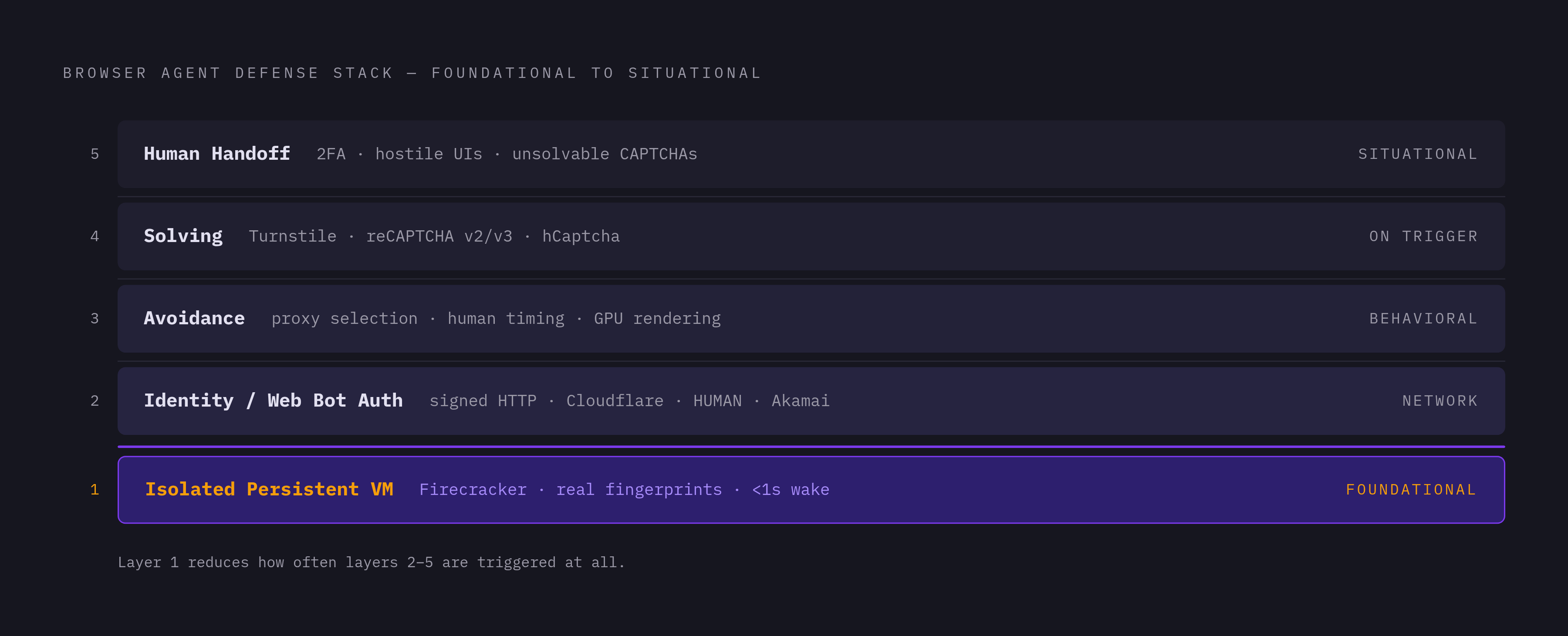
A browser agent built to survive anti-bot detection in production combines the three-layer defense stack with a persistent, VM-isolated identity underneath it. The identity layer reduces how often the other three layers get triggered in the first place, and those layers still handle the cases a strong identity alone cannot resolve.
The foundation is the isolated, persistent VM. Each agent runs in its own micro-VM with its own persistent disk, so browser sessions, cookies, and credentials survive sleep cycles, the hardware fingerprint comes from real virtualized hardware rather than anything emulated, and one agent getting flagged by a detection system has no way of affecting any other agent's standing. On Maritime, this is simply the default setup: a Firecracker micro-VM per agent, a persistent disk, browser authentication that stays signed in, and wake latency under one second.
On top of that foundation sits the identity layer: signing HTTP requests cryptographically through Web Bot Auth wherever the target site supports it, covering platforms like AWS WAF, Cloudflare, HUMAN Security, and Akamai. This should be the first path an agent tries, not a fallback reached for after other methods fail. Below that sits the avoidance layer: proxy selection matched to the target site, human-paced interaction timing, GPU-backed rendering where a site checks for it. These tactics matter less once a session already carries history and valid credentials behind it, but they still matter for any new session that has not yet built that history up. Below that sits the solving layer: asynchronous CAPTCHA token APIs covering services like Turnstile, reCAPTCHA v2 and v3, and hCaptcha, wired in through framework plugins and kept non-blocking so a stuck solve does not stall the whole task. And at the base sits human handoff: CAPTCHA, two-factor prompts, and unfamiliar or hostile interfaces that defeat every layer above get routed to a human checkpoint by design, built into the system from the start rather than bolted on as an admission that something went wrong.
The per-user agent pattern is the structure this architecture points toward. One VM per user means that user's agent keeps accumulating its own browsing history, its own credentials, its own session continuity, run after run. The identity behind that agent grows more credible with every session it completes, and the friction it runs into from anti-bot defenses goes down accordingly because the agent finally has something to show for its past.