The Browser-State Signals That Tell You a Lambda Architecture Has Become a Product Liability
Lost cookies and stale DOMs reveal when serverless fails agents.
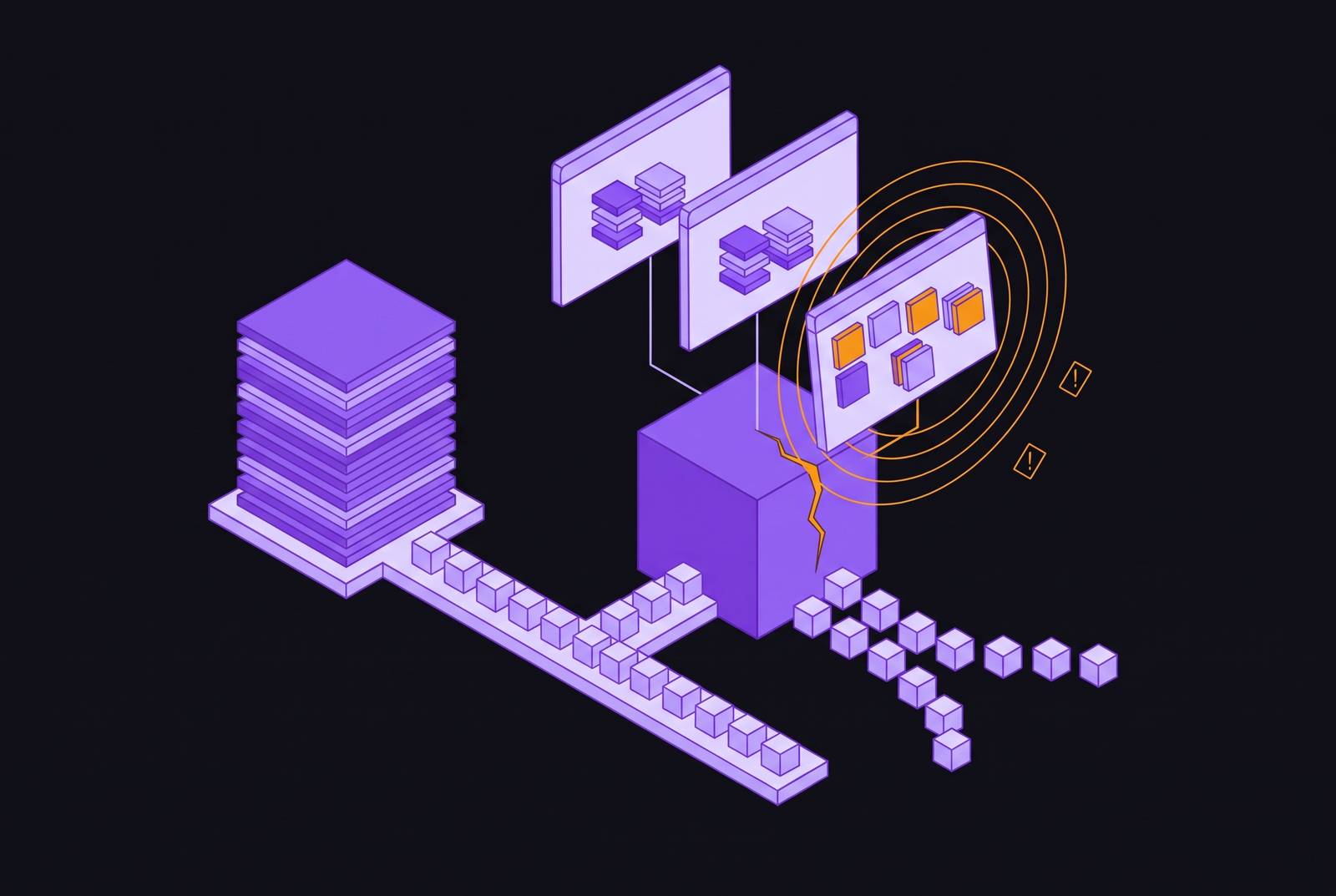
Persistent AI agent infrastructure preserves a browsing session across turns, while stateless serverless functions restart work without restoring the browser’s live context. Session persistence failures, mid-task cookie loss, stale DOM snapshots, and broken authentication state show when that difference puts the product at risk. For agents that depend on browser continuity, the fix is an isolated, resumable session.
Why browser-state failures are a diagnostic signal, not a performance metric
An agent logs in, completes a step, then lands back on the login page when it tries to continue. Or it submits a form using a DOM snapshot from before a redirect. These are not simply slow responses. When the failures line up with execution boundaries, they point to a mismatch between the lifetime of the task and the lifetime of the process doing it.
An agent is a process with a keyboard. It browses pages, writes files, holds authentication context, and executes shell commands across multiple turns. A single function invocation does not need to keep that whole history alive, but a browsing agent often does. Diagnosis therefore requires checking whether the next turn inherits the previous turn’s working environment or merely receives its written instructions. Retry logic can repeat an operation without bringing back the conditions that made it valid.
Why do long-running browsing agents fail on stateless serverless functions?
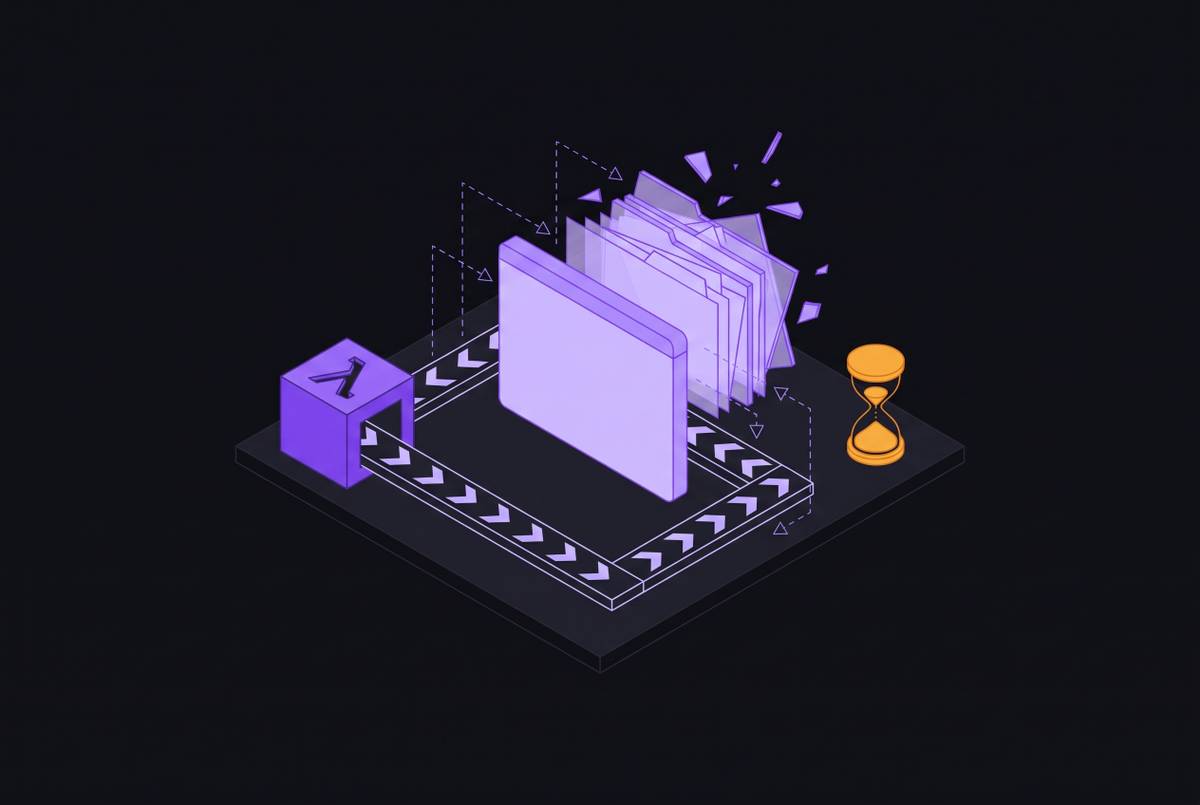
The break occurs when an execution environment is torn down and the next invocation starts a new process. That process has no live memory of what the previous browser loaded, authenticated, or cached. Process-local authentication tokens and cookie state are lost with the old environment unless they are saved elsewhere. Starting again is not the same as resuming.
The DOM introduces a second kind of discontinuity. A snapshot taken in invocation N records the page at that moment, which may differ from the page in invocation N+1. A redirect may have fired, an authentication challenge may have appeared, or a form may have partly completed. If the next invocation acts on the old snapshot, its view and the page have diverged. A longer timeout does not bring that view back in line with the page.
The distinction concerns the execution contract, which allows invocations to start warm. An agent that depends on process-local state fails when that continuity is lost. AWS built Firecracker for Lambda, so Lambda’s invocation model and a Docker/runc shared-kernel container are separate architectural concerns. A workload can have a strong isolation boundary and still lack a way to resume its browser session.
The five isolation levels available in 2026 and where Lambda-style containers fall on that spectrum
The five-level map separates those isolation choices. Level 1 consists of containers such as Docker and Podman, where namespaces and cgroups separate processes that share the host kernel. A kernel vulnerability can cross that boundary. This tier works for trusted code written in-house but is a poor fit for the untrusted code an agent may generate. A Lambda-style deployment built on shared-kernel containers belongs here, but that label does not describe Lambda’s underlying Firecracker isolation.
Level 2 uses a user-space kernel such as gVisor to intercept and reimplement syscalls. The sandboxed program does not talk directly to the real kernel, though some Linux software may not work with it. Level 3 gives each workload its own kernel through hardware virtualization. Firecracker, Kata Containers, and libkrun occupy this microVM tier. Firecracker boots in well under a second with minimal memory overhead.
Level 4 takes a different approach. Microsoft LiteBox links an application against a minimal OS library that gives it a small set of controlled primitives to use. It promises a small attack surface, but remained experimental as of February 2026, with no stable release or production usage. Level 5 adds hardware-encrypted memory isolation through technologies including AMD SEV-SNP, Intel TDX, and ARM TrustZone via OP-TEE. Its purpose is to protect sandbox data even from the host OS and hypervisor, which is relevant to sensitive healthcare and financial workloads.
These levels describe boundaries independently of session persistence guarantees. AWS built Firecracker for Lambda, Google built gVisor for App Engine, Cloud Functions, and Cloud Run, and Azure uses Hyper-V for ephemeral agent sandboxes. Those choices show why “serverless” alone says too little about isolation. Browser-state failures expose lost execution continuity, while the isolation tier determines how far a compromised session can reach.
Why browser-state loss is also a security event, not just a reliability failure
Losing a cookie is not proof of a breach. But a recycled environment that inherits partially authenticated context, or a browser without adequate isolation from its host, creates a security exposure as well as a continuity failure. The question changes from whether the agent can finish to whose credentials and data it can reach.
Shahriar et al. (2026) show how agent capabilities such as file system access, browser control, and shell execution open up new attack vectors. Together, those capabilities become dangerous when an agent follows instructions from a page and can also write Python scripts, install packages, or work with file descriptors. In a shared-kernel environment, the host kernel is still part of the attack surface. Prompt injection can thus lead from a wrong browser action to code execution and put the host at risk of compromise if isolation fails.
A fixed plan offers only partial protection. Del Rosario et al. (2025) describe Plan-then-Execute as a foundation for resilience to indirect prompt injection because it establishes control-flow integrity. The same paper calls for defense in depth, including sandboxed code execution. Application-layer session management may preserve a cookie jar, but it does not create an infrastructure boundary around the code that uses it.
What Firecracker snapshot-restore actually gives an agent that Lambda's cold start cannot
Firecracker snapshot-restore preserves the machine. A snapshot captures memory contents, CPU register state, and device state to disk. On restore, Firecracker memory-maps the snapshot file and loads the CPU state. It does not boot a kernel, run init, or restart the agent. The browser continues from its saved local state.
That is the missing persistence primitive. Memory-resident tokens, cookie state, and the browser’s loaded context are still there when the environment resumes. An external service can still change while the VM sleeps. With a per-session microVM, snapshot-restore handles continuity and isolation in separate ways.
AWS Lambda MicroVMs, announced June 22, 2026, give each user or agent session its own Firecracker microVM, starting from a snapshot and suspending when idle. Each serves one tenant, session, or job and resumes with memory and disk intact for up to 8 hours. Google described Agent Compute Engine on October 22, 2026, with a microVM for each agent session, checkpointed while the model thinks and cloned copy-on-write from warm snapshots. DigitalOcean’s Managed Agents platform also assigns a Firecracker microVM to each session and manages isolation, networking, storage, and checkpoint restore.
How these signals compound in regulated industries where broken agent state also breaks compliance
In healthcare and financial services, a lost session can also disrupt the evidence needed to explain an agent’s actions. HIPAA’s Security Rule has no carve-out for automated access. A retrieval-based clinical agent can bring PHI into the model’s context during retrieval, so access controls must apply to that context as well as the source data. A fresh process does not establish a safe access boundary.
The EU AI Act’s high-risk system obligations are scheduled to become enforceable on December 2, 2027. Auditability makes discarded state especially consequential when the only record of a decision lives in the process being discarded. Stateless execution alone does not show that an audit trail is missing, but process-local evidence is lost at teardown unless it is saved. The compliance failure arises when the system loses the record or access boundary it needs.
A regulated-grade platform therefore needs more than persistent memory. It needs a signed BAA, masking of sensitive data before it reaches the model, an audit trail for every AI decision, and per-session isolation. A microVM provides an execution boundary within which those controls can operate independently of a shared, short-lived browser process.
Human oversight also needs a session to inspect. The same paper by Del Rosario and colleagues identifies Human-in-the-Loop verification as critical for production-grade agents, with particular value during execution before high-risk or irreversible actions. A resumable desktop lets a clinician or compliance officer review or take over the work already in progress.
Reading the signal in your own logs: what browser-state patterns to look for and what each one means
For engineers diagnosing a production system, the practical test is to connect browser events to invocation and resumption boundaries. The first signal is repeated authentication. Look for an agent authenticating at step N, then authenticating again at step N+1 without intervening user action. When that change lines up with an environment teardown, it suggests that process-local session context was lost. Retrying the login sends credentials across another invocation boundary without showing that the agent is back at the correct page state.
The second signal is mid-task cookie loss. HTTP 401 responses or redirects to login, without a target-service session expiry event, point toward a missing browser identity. Those events need to be compared with the service’s session TTL and the Lambda execution window. If the session should still be valid and the cookie loss follows container recycling, the evidence points to the execution environment as the cause. The timing distinguishes two failures that otherwise look alike.
The third signal is action against a stale DOM. Look for attempts to click an element that no longer exists, submit a form already submitted, or read content replaced by a redirect or authentication challenge. Connect the action to the invocation that captured its snapshot. If capture and action straddle an environment rebuild, the agent may be acting on an obsolete page.
The fourth signal appears after a pause. An agent resumes after rate-limit backoff or model-thinking time, then finds a login page or reduced permissions despite no user action. A fresh browser instance at that boundary indicates that authenticated context was restarted. Snapshot-restore preserves the browser’s local authentication state, which makes it materially different from replaying a task description after a cold start.
Attribution completes the diagnosis. Each failure needs a user or tenant association so its product impact and repair scope can be measured. The same session boundary also supports cost attribution, which API-call billing alone can obscure. Spending limits must stop a call before it is sent, rather than merely report an agent loop after it consumes the budget. Reliability and cost controls both need to know which session is doing the work.
What a correct per-session architecture looks like for agents that need persistent browser state
For teams seeing these patterns in production, the replacement is an isolated, resumable computer for each agent or end-user session. Each session runs in its own microVM with hardware-enforced isolation and its own kernel. The VM sleeps when idle and resumes from snapshot in roughly one second, preserving the browser’s cookies, DOM state, and authenticated context. Per-second metering makes that session the unit of cost as well as execution.
Untrusted or LLM-generated code belongs inside a disposable sandbox whose disk is deleted when the task ends. It must not share a process boundary with application credentials or production data. A human also needs a way to connect to the desktop during execution to inspect, redirect, or take over regulated work. These properties require architectural support.
The computer environment also enables useful work. Cheng et al. (2026) demonstrate that a minimal code sandbox, without additional training, produces gains across mathematics, physics, chemistry, biomedicine, long-context understanding, and instruction following while reducing token consumption by up to 8 times. The sandbox is therefore more than protective overhead. When production logs tie browser-state failures to lost execution continuity, preserving that environment becomes the migration criterion. The task must outlive the invocation without losing the computer performing it.