Why a Lambda Timeout Loop in Your Browser Agent Is a Browser-State Problem Not a Duration Problem
Browser agents need persistent state, not longer timeouts, to survive serverless function limits.
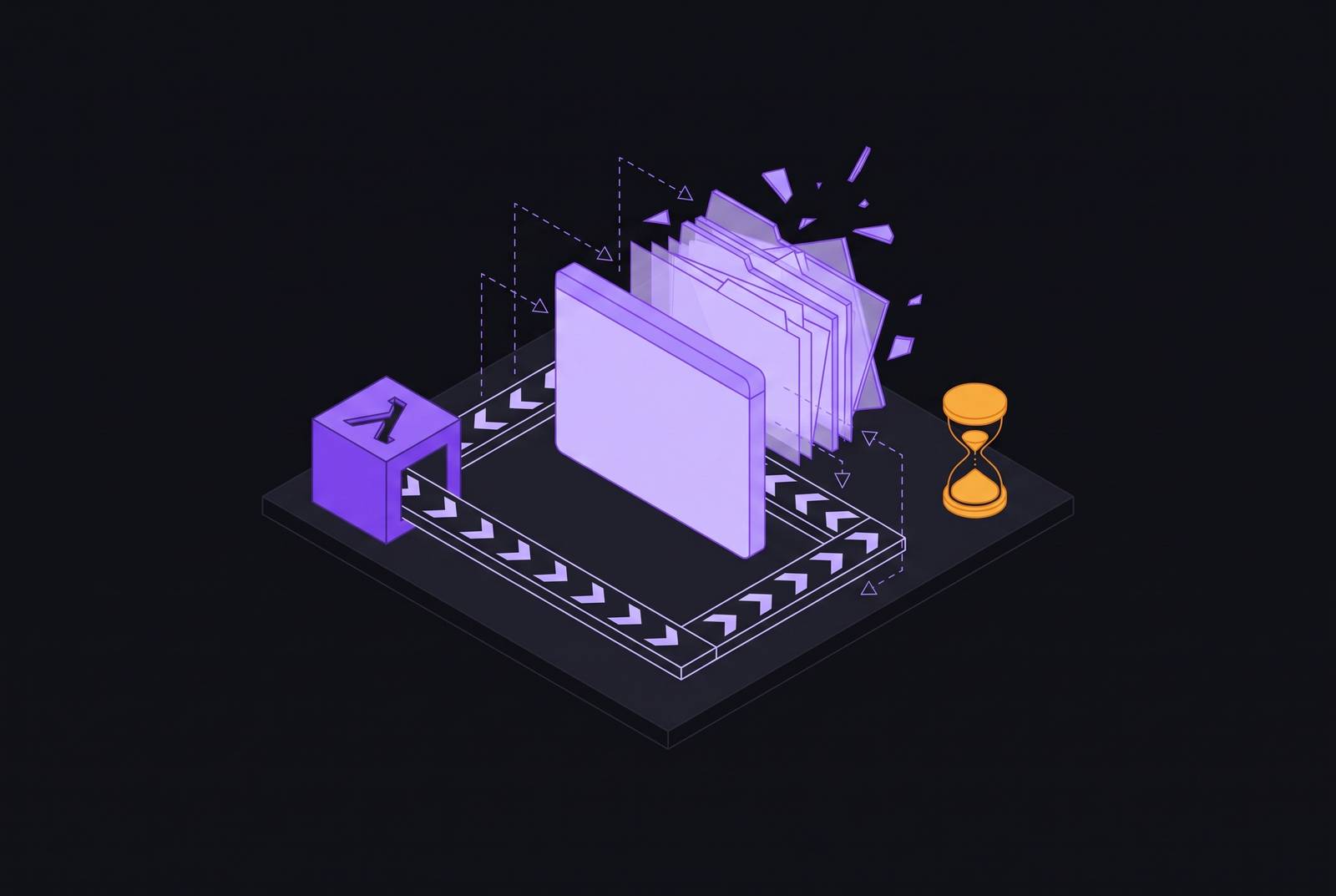
A Lambda timeout loop in a browser agent is a browser-state problem. Serverless functions limit how long execution can run, while persistent AI agent infrastructure must keep the browser session alive from one execution to the next. Moving that session into a persistent, isolated environment makes a timeout a scheduling interruption rather than the loss of authenticated, partially completed work.
Why browser agents break differently from ordinary Lambda timeouts
The Lambda timeout loop begins when a browser agent loses the session that gives its next action meaning. Every step depends on earlier steps, including which pages were visited, which sessions are authenticated, and which forms are partially filled. A retry needs more than another attempt at the latest instruction. It first needs the browser context in which that instruction was supposed to run. That dependency makes a browser agent a different workload from an ordinary function.
AWS documents Lambda’s environment lifecycle around initialization, invocation, and shutdown, with an environment that may be frozen after an invocation and reused later. That model works well for short request-response work, but the chance of reuse does not ensure browser-session persistence. The session includes live WebSocket connections to Chromium through the Chrome DevTools Protocol, or CDP, as well as cookies, open tabs, and DOM position. Some components can be recorded separately. The complete session, however, cannot be reduced to a key-value tuple and restored as readily as a queue message. Lambda’s 15-minute cap becomes destructive when reaching it also ends the only environment holding that context.
What actually dies when a Lambda timeout hits a browser agent
A timeout does not pause the browser agent. When the browser lives inside the execution environment that the timeout ends, the process-resident session is lost and cannot resume. The lost state includes authenticated sessions, cookies, navigation history, partially filled forms, and DOM position. These are not merely descriptions of completed work. They are the live context from which the browser would have performed the next action.
A control plane first selects a machine with capacity, and that machine restores a saved browser VM. Chromium then starts and reaches a controllable state before a connection URL returns to the agent. Everything added after the connection is made belongs to that running session. Restoring an initial VM image recreates the starting environment and restores later browser state only if that state was itself captured.
This distinction also defines the boundary of the failure. If the browser resides in an independently persistent environment, ending the agent process need not destroy it. If both end at the same time, though, a new connection URL cannot bring back the memory lost with the old process.
How teams misread the symptom and reach for the wrong fixes
The word “timeout” directs attention toward elapsed time. Teams increase the allowed duration, divide work into shorter invocations, or move execution to ECS Fargate. Each can change when execution stops. None, by itself, changes what survives the stop. The diagnostic error is treating a longer opportunity to finish as a way to resume unfinished work.
Chunking exposes this distinction at the handoff. A coordinator can schedule the next chunk, but it cannot give that chunk a browser session that no longer exists. The next invocation must start fresh or re-authenticate, which may not be possible programmatically. A chunking strategy can work until one chunk exceeds the execution limit. At that point, a coordinator without preserved browser state can retry, but it cannot resume.
Fargate lifts that same short execution deadline, but a task failure can still lose the state held in the process. Node replacement, an OOM kill, or an upstream 5xx can lead to a restart that repeats completed work and its LLM token cost. AWS Lambda durable functions address execution durability at the function layer, but that is not equivalent to preserving Chromium’s live session. A durable wrapper still needs an environment that holds the browser.
The root cause: stateless environments have nowhere to put browser state
Chromium, its cookies, open tabs, authenticated sessions, and DOM position must persist when the agent process is not running. The next invocation must reconnect to that state instead of opening another browser and retracing earlier navigation. The environment also needs a boundary per session, so one agent’s failure cannot corrupt another agent’s browser context. Persistence concerns both lifetime and ownership.
Neither a Lambda invocation nor a Fargate task provides that complete contract. Lambda’s possible environment reuse does not provide durable local state across invocation boundaries, while Fargate does not restore browser session state across task restarts. A longer-lived process leaves the underlying dependency intact. When that process is the only home for the session, process death remains session loss.
An invocation takes work and returns a result, while a workspace keeps the context needed to pick up the work later. Browser agents need the latter even when their control logic runs through the former.
Why the idle-billing structure compounds the statelessness problem
The same mismatch imposes a second penalty through billing. Browser agents move between doing work and waiting for model responses, tool calls, and API replies. Amazon Bedrock AgentCore’s pricing page characterizes agentic workloads as typically spending most of their time in I/O wait. Wall-clock billing runs through those pauses, charging for waiting time when an environment is kept alive to preserve state.
Crashes also waste money when sessions are left open. The agent may have stopped making progress while an orphaned session continues to incur cost. This is distinct from the re-initialization tax after state loss. That tax comes from rebuilding the browser environment at the start of another invocation before the agent can get back to its task.
Duration tuning addresses neither cost reliably. Chunking can avoid some timeout failures without changing wall-clock session billing, and longer-lived tasks can keep a session only while they stay alive. Persistence and billing therefore need separate evaluation. An environment can keep state as it should and still charge for the time the agent spends waiting.
Snapshot-restore: how a persistent VM turns timeout into a scheduling event
Browser Use’s June 2026 infrastructure post describes a production design in which each browser session runs in a tiny Firecracker VM resumed from a snapshot. The snapshot is taken just before Chromium launches, so each new session still starts Chromium after the VM resumes. The team achieved VM startup under 400ms. That is a concrete VM-per-session implementation, but its snapshot boundary needs careful interpretation.
The same post identifies snapshotting after Chromium is already running as the next step. Its startup result therefore does not show that it can bring back an authenticated browser halfway through a task. Initial provisioning and interrupted-session recovery are different operations. A pre-launch snapshot accelerates the former without, by itself, supplying the latter.
For interrupted-session recovery, the snapshot must capture the browser state that execution needs to resume. That includes controllable Chromium, intact authentication cookies and session tokens, preserved tabs and DOM state, and a CDP endpoint ready for reconnection. With that persistence boundary, the agent’s invocation can end without requiring the next invocation to reconstruct the browser.
Isolation as a requirement, not a bonus: why a micro-VM per session matters beyond persistence
A browser agent brings together private data, untrusted website content, and channels through which it can communicate with the outside world. That combination makes isolation a structural requirement. Preserving a session is insufficient if another compromised session can read its cookies, tokens, or browser history. The architecture must limit both what disappears after a crash and what becomes reachable after a compromise.
The ceLLMate research paper showed HTTP-layer sandboxing for browser-using agents with a Chrome extension that enforced default-deny outbound policies. Frontier LLMs achieved policy prediction accuracy above 94%, and all 12 emulated prompt injection attacks were blocked with modest latency overhead. These results show how the tested policy-enforcement mechanism performed. They show why controls around an agent’s external actions are necessary.
A micro-VM per session addresses a related boundary by separating one session’s browser state from another’s. Shared browser processes or shared filesystems do not provide that same per-session separation merely because the application assigns different session identifiers. The VM limits what one session can expose to another, but the agent is still open to attacks from hostile content. Persistence and isolation thus both call for a VM for each session with its own kernel, along with controls over what the agent may send outward.
What the protocol layer reveals about where infrastructure must be stateful
MCP’s July 2026 spec update moved its protocol core from stateful, session-per-client connections toward stateless, self-contained requests. The official MCP blog describes the change as a move from a bidirectional stateful protocol to a request-response stateless protocol. The official changelog records the removal of protocol-level sessions and the handshake, with each request supplying its protocol version and client capabilities.
That direction does not contradict persistent browser infrastructure. The two layers have different jobs. The protocol defines how an agent communicates with tools and services, while the execution environment holds the browser context those requests operate on. Stateless requests can support horizontal scaling without making the browser disposable. The mistake is extending a useful property of the communication layer into a requirement that every execution environment forget its past.
This separation also clarifies the developer experience. CLI, SDK, and MCP integrations can connect code to a live agent endpoint without becoming substitutes for browser-session persistence. When the environment retains the session, protocol tooling does not need to rebuild session management, state externalization, or checkpoint infrastructure.
What fixing the environment actually looks like for a team shipping a browser agent today
For a team choosing between persistent AI agent infrastructure and serverless functions, the practical test is what survives interruption. Does process death destroy authenticated session state? Does a new invocation have to re-navigate or re-authenticate before continuing? Either outcome identifies a persistence gap, regardless of how long the function or task is allowed to run. A duration setting is not a recovery contract.
The evaluation also needs to distinguish persistence from economics and isolation. Does the bill keep growing through every pause for an LLM response, and can a compromised session reach another user’s browser state? These questions test separate properties of the environment. All three belong in the infrastructure decision.
The recommended primitive is a persistent, isolated VM per session that snapshots Chromium’s live state, restores it in under a second, auto-pauses when idle, and bills for storage during idle time. Those are criteria for choosing a system, and a fast VM-startup measurement alone does not show that a system meets them. The Skill.re case illustrates that the migration can leave the agent’s logic and Slack workflow unchanged while replacing the execution substrate. The architectural payoff is subtraction. Queues, retry handlers, checkpoints, idempotency keys, and cleanup jobs added to compensate for disposable browser state no longer have to stand in for an environment the agent can return to.